
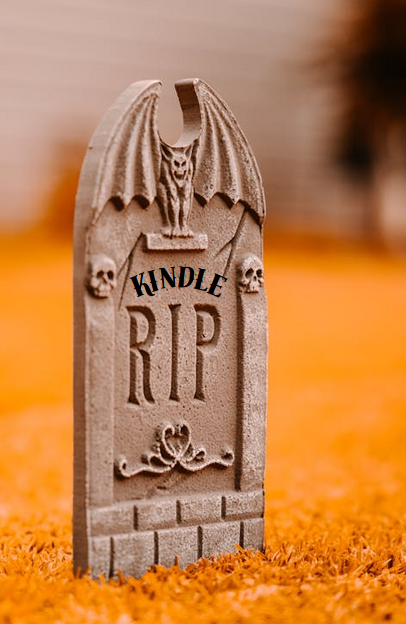
Today is the day Amazon pulls the plug. As of 20th May 2026, the company has officially cut store support for all Kindle devices released in 2012 or earlier. Not because they are broken. Not because they are unsafe, but because Amazon has decided they are no longer worth maintaining. Millions of customers who trusted the company with their reading lives are paying the price for that decision today, whether they were ready for it or not.
Let us be clear about what is actually happening here. This is not a technical necessity. It is a commercial choice. A Kindle is a device that displays text. It does not run social media algorithms or process banking transactions. It shows you words on a page. That function does not expire. These devices work. Amazon is choosing to make them not work.
A Kindle is a text device. There is no need for updates.
Amazon’s Defence – and Why It Does Not Hold Up
Amazon’s response has been to point out that affected models have been supported for 14 to 18 years, as though longevity of support is a reason to forgive what is happening at the end of it. Discounts have been offered. E-book credits have been dangled. Previously downloaded books will still be readable, we are told, as if that makes up for stripping the device of its primary purpose. It does not. And there is a detail Amazon has been conspicuously quiet about: performing a factory reset on an affected device after today will render it completely and permanently unusable. The option to wipe it and hand it to a friend, a family member, a child has gone. Amazon has not just ended support it has actively ensured these devices cannot even be repurposed.
Real People, Real Loss
Owners of affected devices, including the original Kindle (2007), the Kindle Touch (2011), the first-generation Paperwhite (2012), and several Kindle Fire tablets are not abstract statistics. They are people who made a choice to invest in a device and an ecosystem, and who are now being told that investment has an expiry date set entirely by the company that took their money.
Kay Aaronricks, 46, told the BBC she had not anticipated the sadness she felt on hearing the news. Her 14-year-old Kindle has been a near-constant companion through work and travel. She also noted something that should give Amazon pause: she does not want the adverts that come baked into newer discounted devices. Her Kindle was, for her, a sanctuary from the commercial noise of the modern world. Amazon’s upgrade path offers her more of that noise, not less. That is not a solution. That is an upsell dressed up as one.
The Environmental Betrayal
Perhaps the most galling aspect of this decision is the environmental dimension. Ugo Vallauri, co-director of the Restart Project, estimates that approximately two million devices now face obsolescence, potentially generating over 624 tonnes of e-waste.
Think about who those two million people are. Many of them chose a Kindle precisely because it was the responsible choice. One device. Thousands of books. No printing, no paper, no packaging shipped around the world for every title. For readers who cared about their footprint, it was an obvious decision and a good one. Amazon sold them that vision. And today, Amazon is the reason those same devices; bought in good conscience, used with care, are destined for a landfill. Not because they failed. Because Amazon decided they were inconvenient.
There is a word for selling people an environmentally virtuous product and then engineering its premature obsolescence. It is not a flattering one.
This sits within a much larger and long-overdue debate about the right to repair. Digital devices and software support remain almost entirely outside existing right-to-repair frameworks in both the UK and EU. Until that changes, companies like Amazon retain the unchecked power to decide when your device becomes a paperweight, regardless of whether it still functions, regardless of what you paid for it, regardless of where it ends up. That is not acceptable. And it is long past time legislators treated it as the consumer rights issue it plainly is.
What Can You Actually Do?
If you own an affected device, your options are limited but they exist. Your already-downloaded books remain readable, so keep using the device for those, and do not, under any circumstances perform a factory reset, which Amazon has confirmed will make the device permanently registrable.
You can side-load new books via USB using free tools like Calibre, purchasing from other retailers such as Kobo (there are others) and converting the files across.
A growing number of owners are choosing to jailbreak their devices and install KOReader, a free open-source reader that supports EPUB, PDF, and more, operating entirely independently of Amazon – a fitting response, frankly.
Loading the device with free public domain titles from Project Gutenberg and passing it to a child is another excellent option, and one that keeps it out of the bin where Amazon seems content to let it end up.
If you do need a new device, do yourself a favour and look beyond Amazon first. Kobo offers a superior ecosystem in several respects: native EPUB support, library lending via Libby, no adverts on the home screen, and no track record of pulling the rug from under its users. Onyx Boox runs Android and gives access to virtually any reading app. PocketBook offers wide format support with no ecosystem lock-in. Any of them is a reasonable alternative to rewarding Amazon’s behaviour with another purchase.
The Conclusion That Was Always Coming
Amazon has spent two decades building one of the most loyal customer bases in consumer technology. Kindle owners are not casual users. They are readers, people for whom a device is not a gadget but a habit, a comfort, a companion.
Today, Amazon has told millions of them that their loyalty has a shelf life, and that shelf life is determined entirely by what is commercially convenient for a trillion-dollar company.
The greenest Kindle is the one you already have. Amazon just made sure you can’t use it properly any more.
The books on your shelf will outlast every company that ever printed them. The same cannot yet be said for the books in your cloud — and Amazon has just reminded us exactly why.
References and Further Reading
1. Amazon to end support for older Kindle devices – TechCrunch, 8 April 2026
2. Amazon Is Discontinuing Support For These Older Kindle Models – BGR, 8 April 2026
3. Users turn to jailbreaking their older Kindles as Amazon ends support – TechCrunch, 16 May 2026
4. Amazon ends support for older Kindle devices, leaving millions unable to download new ebooks – Hardwood Paroxysm / Press Association, 10 April 2026 (includes Ugo Vallauri / Restart Project and Paolo Pescatore comments)
5. Amazon is turning 2 million old Kindles into bricks this May – Boing Boing, 9 April 2026
6. OG Kindle owners are staging a jailbreak revolt – XDA Developers, 18 May 2026
10. 13 Kindle Models to Lose Amazon Support – Today.com, 10 April 2026
11. KindleModding.org – post-jailbreak guides and FAQ
12. KOReader – official installation documentation
13. Calibre – free open-source e-book management software
14. Project Gutenberg – free public domain e-books
Note: Jailbreaking a Kindle may breach Amazon’s terms of service. In most jurisdictions it is not a criminal matter for personal use, but readers should consult local law before proceeding. DRM removal exists in a legal grey area that varies by jurisdiction.
| Photo Credits |
|---|
| Photo by Juan Vargas https://www.pexels.com/photo/gray-tombstone-on-grass-in-yard-5432189/ |